
Reviewed · CHINA TEMPLE TOURS
200-year-old Hakka Residence Tour +Ancient Buddhist temple
Shenzhen’s modern towers tell only part of the story. This tour takes you to a huge 200-year-old Hakka residence, where kitchens, classrooms, furniture, and family rooms still show how people lived in imperial China. You’ll then visit a peaceful Buddhist temple said to be 1,000 years old, followed by views of the restored Longgang River wetlands.
I like the strong contrast between Shenzhen’s technology-driven present and its older village life. I also like the small group, limited to five people, and the personal English guidance from Jimmy, whose humor and patience have earned especially warm praise. The main drawback is that this is a walking tour with no meal or water included, so comfortable shoes and your own bottle matter.
Key points to know before booking
- The Hakka residence covers about 25,000 square meters, with more than 300 rooms in its original layout.
- Historic kitchens and Confucian classrooms remain visible, giving the visit more substance than a quick photo stop.
- The Buddhist temple includes several structures and a pagoda dedicated to a lady god, where locals come to pray for luck and fortune.
- The Longgang River was restored through wetland work, after once being considered one of Shenzhen’s most polluted rivers.
- The tour begins at 2pm at Nanlian Metro Station Exit C1, about 60 minutes by MTR from Luohu.
- The $47 price includes guiding and transportation between sites, but not food or water.
Why this tour matters in a fast-changing Shenzhen
Shenzhen grew from a small settlement into a major modern city in only about 30 years. That speed brought skyscrapers, roads, and technology parks, but it also erased much of the older city. This outing gives you a useful correction to the usual Shenzhen story.
You are not simply looking at old walls. You are seeing the remains of a Hakka clan residence and learning how an extended family organized daily life. The Hakka people migrated from central China toward the Shenzhen area roughly 500 years ago, bringing their own customs, settlement patterns, and family traditions.
The tour is particularly useful if you have already seen Shenzhen’s shopping districts and high-rise neighborhoods. It gives you a sense of the people and communities that existed before the city became a global technology center. I find that contrast more interesting than another viewpoint or shopping mall.
At $47 per person, the price is reasonable if you value a guide who can explain what you are seeing. You are paying for a small group, English guidance, and transport between the sites, not just admission to a collection of old buildings. Since the tour lasts 2.5 hours, it also fits neatly into a free afternoon.
Other temple visits near China we have written up
- Mini Group Xian Day Tour to Terracotta Army, City Wall, Pagoda and Muslim Bazaar
★ 5.0 · 1,320 reviews - Beijing: The Temple of Heaven or Summer Palace Entry Ticket
★ 4.6 · 1,286 reviews - Beijing Classic Full-Day Tour including the Forbidden City, Tiananmen Square, Summer Palace and Temple of Heaven
★ 4.0 · 610 reviews
Meeting Jimmy at Nanlian Metro Station
The meeting point is Nanlian Metro Station on Line 3, Exit C1, at 2pm. From Luohu, allow about 60 minutes on the MTR. That travel time is not a flaw, but it does mean you should plan your afternoon carefully and avoid arriving at the station at the last minute.
Nanlian puts you outside the central tourist core. That is part of the appeal. You are moving away from Shenzhen’s dense modern center and toward places where older local life is easier to see.
The group is limited to five participants. This matters on a walking tour through old buildings, where a large crowd would make explanations harder to follow. A small group also gives you a better chance to ask about family life, religious customs, architecture, and Shenzhen’s changing environment.
English is the tour language. Jimmy is the named guide associated with the experience, and his style combines historical explanation with humor. He is also described as patient with questions. A colleague may lead the tour instead, so you should not assume Jimmy will always be present, but the format remains an English-led small-group outing.
Entering the 25,000-square-meter Hakka residence
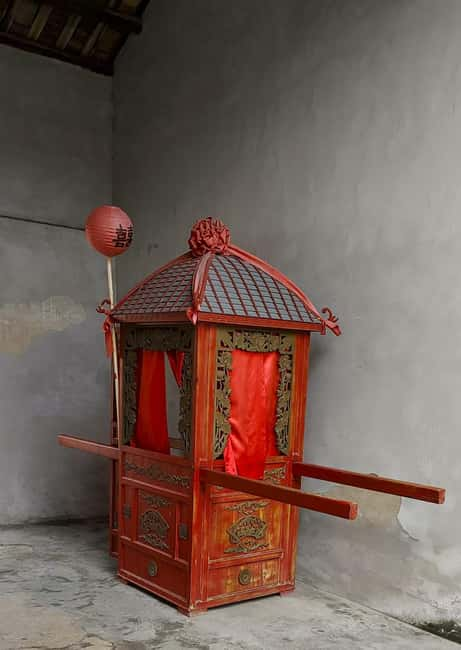
The first major stop is the Hakka housing complex built by the Luo clan about 200 years ago. It contains more than 300 rooms and covers roughly 25,000 square meters, making it much larger than the small ancestral homes many people picture when they hear the word Hakka.
The size helps you understand how family and community life worked. This was not simply one household with a few bedrooms. A large clan residence could organize people, work, education, cooking, worship, and family obligations within one connected setting.
You can still see the original layout and surviving furniture. That gives the guide something real to point to. Instead of hearing only dates and names, you can connect the explanation to rooms that were actually used.
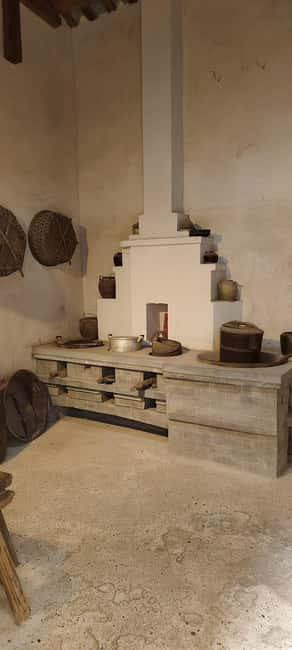
The historic kitchen is one of the most useful details. It remains intact and is still ready for cooking. A kitchen tells you more about ordinary life than a formal entrance often does. Look for the practical side of the building: where food was prepared, how space was divided, and how a large family might have managed daily meals.
The former classrooms are another strong feature. Children studied Confucianism there, offering a glimpse of education in imperial China. This is an important reminder that an old residence was also a social institution. It was a home, school, workplace, and family center at once.
The building’s scale may be difficult to take in during a short visit. You cannot study every room in 2.5 hours, especially since the tour also includes a temple and river area. I would focus on the overall plan, the best-preserved rooms, the kitchen, and the classrooms rather than trying to inspect every corner.
What the Hakka buildings reveal about daily life
The value of the residence lies in ordinary details. Grand palaces tell you how rulers wanted to be seen. A clan house can show you how regular families arranged life, authority, work, and learning.
The Luo clan built this complex two centuries ago, but the wider Hakka story reaches further back. Hakka communities moved from central China toward southern regions around 500 years ago. Their presence around Shenzhen helps explain why the city’s past cannot be reduced to its recent rise as a financial and technology center.
You may notice that the original layout makes the residence feel more like a small community than a single home. That is the point. Family identity mattered, and the building was designed around shared life rather than modern privacy.
I especially like that the tour includes the kitchen and classrooms. These are not decorative extras. They help you picture food preparation, children’s lessons, and the routines that supported a large family compound.
Bring patience. Old residences are best read slowly, and the walking surface may not feel as easy as a modern museum floor. The official advice is to wear comfortable shoes, and I would take that seriously. Pregnancy is listed as a reason this activity may not be suitable, so anyone with mobility or comfort concerns should consider that before booking.
A different set of gates, same trip:
- Temple of Heaven Ticket
★ 5.0 · 482 reviews - Temple Heaven, Lama Temple, Summer Palace & Peking Duck Bus Tour
★ 5.0 · 377 reviews - Best of Shanghai Day Tour, including Jade Buddha Temple & Bund & Yuyuan Garden
★ 4.0 · 338 reviews - Temple Heaven, Summer Palace, Lama Temple, Hutong Bus Tour
★ 4.7 · 319 reviews
A quieter hour at the 1,000-year-old Buddhist temple
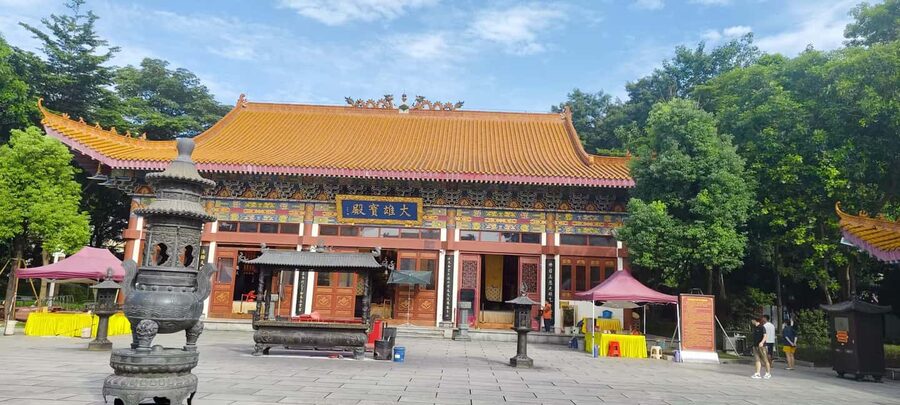
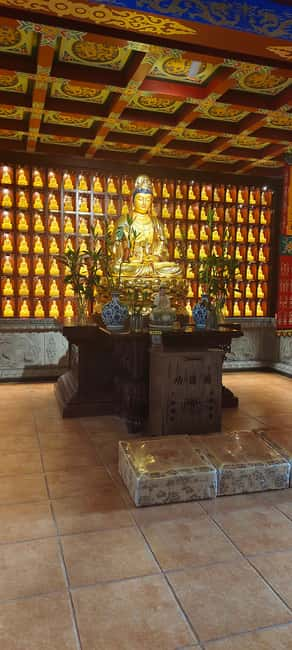
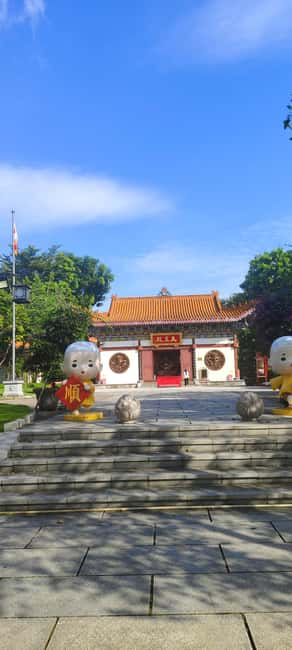
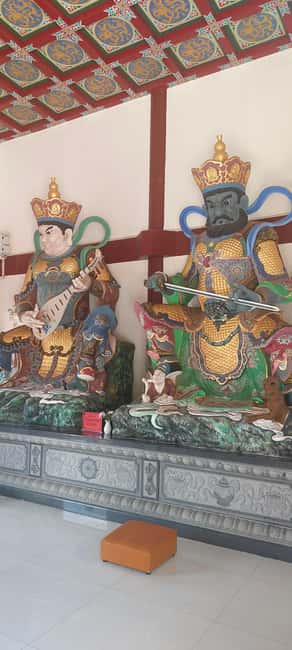
The second major stop is a Buddhist temple described as 1,000 years old. The monastery includes several structures, creating a broader religious setting rather than one isolated hall.
The atmosphere changes sharply after the large residence. The Hakka complex is about family organization and daily activity. The temple is quieter and more reflective. You can walk around, look at the buildings, pray, and learn about the religious traditions connected to the site.
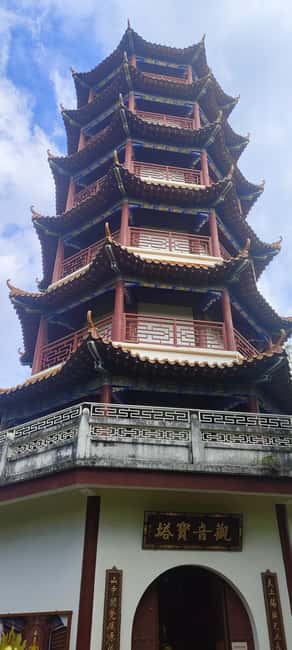
One notable feature is a pagoda dedicated to a lady god. Local people come there to pray for luck and good fortune. You do not need to share those beliefs to appreciate the role the pagoda plays. It remains a living place of worship, not just an old structure preserved for photographs.
Please treat the temple as a religious site first and a sightseeing stop second. Walk respectfully, follow the guide’s instructions, and avoid treating prayer areas as simple backdrops. The tour allows you to learn and look around, but the setting calls for a quieter pace.
The temple has also been renovated. That means the buildings may look more orderly and complete than the Hakka residence, whose original rooms and furnishings provide a more direct sense of age. The contrast is useful: one stop shows old domestic life, while the other shows a maintained religious tradition.
Photography should be rewarding here, especially for visitors interested in traditional Chinese structures. Still, the best reason to linger is not just the architecture. The peaceful setting offers a pause from Shenzhen’s traffic and dense city life.
Following the restored Longgang River wetlands
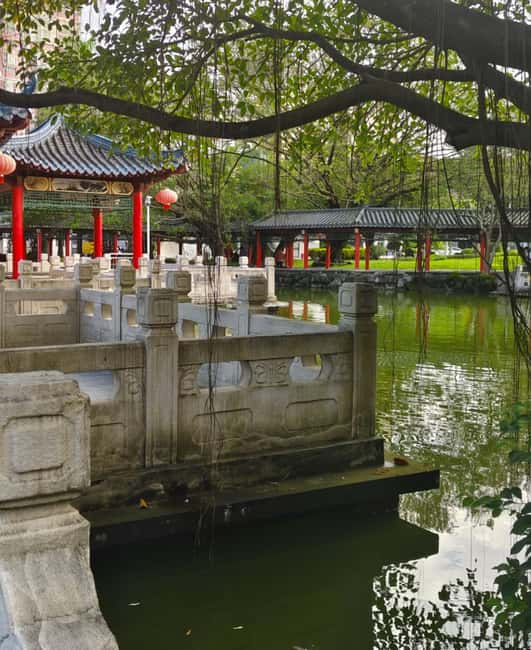
The final major element is the Longgang River, a natural waterway that flows toward the Shenzhen River, the river separating Shenzhen from Hong Kong. The river was once considered one of the most polluted in Shenzhen.
During the last decade, it was rehabilitated by creating wetlands that help filter pollution. That environmental work gives the river stop a clear purpose. You are not only looking at water and scenery. You are seeing how a damaged urban river can be brought closer to a natural state.
The wetland area also gives the tour a welcome change of pace. After enclosed rooms and temple buildings, you have open views and fresh context for Shenzhen’s growth. The city’s development has created serious environmental pressure, but this restoration effort shows that improvement is possible.
The information provided does not promise a long nature walk or wildlife viewing, so do not book this expecting a full birding excursion. Think of the river as a scenic and environmental part of the route, a chance to understand the city beyond its buildings.
The river connection is also geographically interesting. The Longgang River runs into the Shenzhen River, linking this quieter stop to the larger border region. That makes the outing feel connected to Shenzhen rather than like an isolated historical attraction.
How the 2.5-hour schedule works for you
The entire experience lasts 2.5 hours. That is enough time for a focused introduction to the residence, temple, and river, but not enough for a slow museum-style examination of every room.
The tour includes transportation between the sites, which is important because the three parts are not presented as one continuous walk. You still need to walk at each stop, and the activity is described as a walking tour. Comfortable shoes are essential.
Food and water are not included. Bring your own bottle and consider eating before the 2pm meeting time. A 2.5-hour outing is not especially long, but warm weather and walking can make hydration important.
The afternoon start works well for visitors who want a morning in central Shenzhen. It also means you should check the day’s availability and make sure the MTR journey from Luohu fits your schedule. The meeting time is fixed at 2pm, so this is not a casual drop-in activity.
The small group makes the timing more manageable. With no more than five people, the guide can keep the pace together and answer questions without the delays that often come with a large tour bus.
Who will get the most from this experience
I would recommend this outing to you if you want Shenzhen history beyond recent skyscrapers, shopping, and technology. It suits curious first-time visitors, repeat visitors who have already seen the central districts, and anyone interested in architecture, family history, religion, or urban restoration.
It is also a good choice if you prefer a guide-led experience. The old buildings are more meaningful when someone explains why the rooms exist and how Hakka families used them. Jimmy’s clear English, humor, and patience with questions are valuable qualities for this type of visit.
Families with older children may find the kitchens, classrooms, and large clan layout easier to understand than a formal historical lecture. The temple and river also break up the visit, keeping the outing varied.
I would be more cautious if you dislike walking, need a highly accessible route, or want a very slow architectural study. The tour covers three different settings in 2.5 hours, and pregnancy is specifically listed as a reason not to take it. You should also reconsider if you want meals, bottled water, or a full-day excursion, since none of those are included.
Is the $47 price fair?
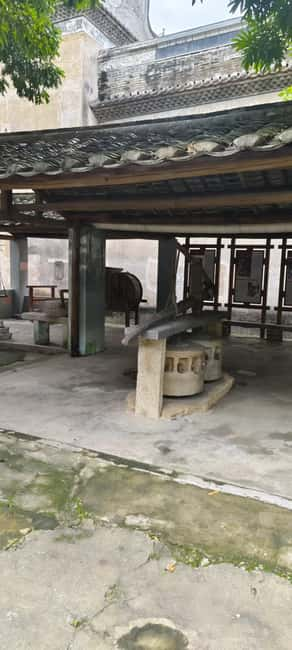
For $47, you receive an English-speaking guide, transport between the sites, and a small group capped at five people. That is good value for someone who wants interpretation rather than simply directions and entry points.
The price is less compelling if you are comfortable exploring independently and only want to take photographs. The residence and temple may be accessible without paying for a guided format, though the supplied information does not specify independent admission arrangements. The real value here is the explanation of what you are seeing.
A five-person maximum is worth noting. Private tours often cost much more, while large group tours can feel impersonal. This sits between those formats, giving you a more personal setting without being described as a fully private tour.
Free cancellation is available up to 24 hours before the start, and you can reserve now and pay later. Those terms help if your Shenzhen plans are still moving around. Still, check availability before building your day around the 2pm departure.
Should you book this Shenzhen history tour?
Book it if you want to see a side of Shenzhen that modern city tours usually miss. The large Luo clan residence, with its original layout, working-style kitchen, furniture, and Confucian classrooms, is the strongest reason to go. The 1,000-year-old temple adds a calm religious setting, while the restored Longgang River gives the afternoon an environmental angle.
The tour is especially worthwhile when you value a good guide. Jimmy’s clear English, humor, and willingness to answer questions can turn old rooms into understandable human stories. Just plan for the long MTR ride from Luohu, bring water, wear comfortable shoes, and remember that the tour moves at a walking pace.
If your ideal Shenzhen day means high-rises and shopping, skip this one. If you want family life, faith, and river restoration alongside the city’s modern story, the $47 price is a sensible use of an afternoon.
FAQ
How long does the tour last?
The tour lasts 2.5 hours.
Where does the tour meet?
The meeting point is Nanlian Metro Station, Line 3, Exit C1. The Chinese name is 南联站 C1出口.
What time does the tour begin?
The meeting time is 2pm.
How far is Nanlian Metro Station from Luohu?
The meeting point is about a 60-minute MTR ride from Luohu.
What language is the tour conducted in?
The tour is conducted in English.
How large is the group?
The group is limited to five participants.
Is transportation included?
Transportation between the tour sites is included.
Are meals or water included?
No. Meals and water are not included, so bring your own water and arrange food separately.
Is this a walking tour?
Yes. The activity is described as a walking tour, and comfortable shoes are recommended. Pregnancy is listed as a reason the tour may not be suitable.
Newly written up around China
- Private Day to T-Square, Forbidden city, Temple of heaven, Summer palace Tour★ 5.0 · 54 reviews
- Private Day Trip of Forbidden City, Temple of Heaven and Summer Palace★ 4.5 · 3 reviews
- Private Tour to Lama Temple, Tian’anmen Square and Forbidden City★ 5.0 · 3 reviews
- Private Half-Day Temple of Heaven and Lama Temple Tour★ 5.0 · 13 reviews
- Private Day Tour:Tiananmen Square,Forbidden City Temple of Heaven★ 5.0 · 16 reviews
- Private Tour to the Temple of Heaven and Tea tasting at the Maliandao Tea city★ 5.0 · 3 reviews
- Local’s Beijing: Forbidden City Insider Tour +Temple +Duck Feast★ 4.5 · 66 reviews
- Temple of Heaven Ticket with Optional Guide Service★ 5.0 · 120 reviews
China Temple Tours, compared.
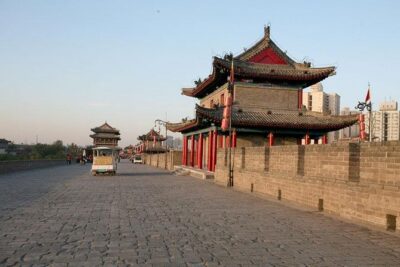
Mini Group Xian Day Tour to Terracotta Army, City Wall, Pagoda and Muslim Bazaar
Read our review →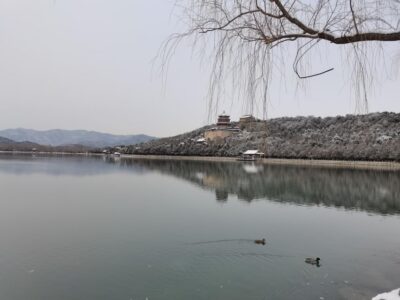
The Temple of Heaven or Summer Palace Entry Ticket
Read our review →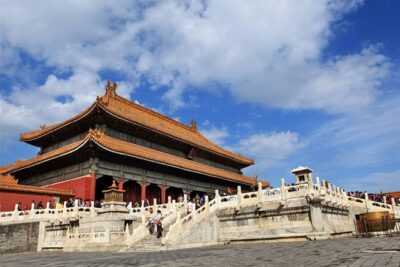
Beijing Classic Full-Day Tour including the Forbidden City, Tiananmen Square, Summer Palace and Temple of Heaven
Read our review →
Temple Heaven, Lama Temple, Summer Palace & Peking Duck Bus Tour
Read our review →
Best of Shanghai Day Tour, including Jade Buddha Temple & Bund & Yuyuan Garden
Read our review →
Temple Heaven, Summer Palace, Lama Temple, Hutong Bus Tour
Read our review →
Browse the lists this tour appears in