
Reviewed · MADRID TEMPLE TOURS
Escorial Monastery and the Valley of the Fallen Tour from Madrid
The most striking part of this half-day trip is the contrast between El Escorial’s royal monastery and the Valley of the Fallen, a solemn Francoist monument cut into the Sierra de Guadarrama. One site speaks of Philip II, royal power, art, and Catholic devotion. The other forces you to think about Spain’s Civil War and the politics of memory.
I like two things right away: you get admission to both places without arranging separate transport, and the bus leaves from central Madrid at 9 a.m. Guides including Cristina, Bea, Luis, and Oscar have earned praise for bringing the history and art to life. The main caution is that bilingual commentary can make the tour feel slower, and a few people have had trouble with the radio equipment.
Key points to know before booking
- Two very different monuments in about five hours: El Escorial provides royal art and architecture, while the Valley of the Fallen offers a more difficult look at Spain’s twentieth-century past.
- A practical escape from Madrid: The air-conditioned bus with Wi-Fi handles the trip to the foothills, where reaching both sites without a car is less convenient.
- Guided entry is included: You receive admission to the monastery and the Valley of the Fallen, along with commentary from a professional guide.
- English may be shared with Spanish: The tour is offered in English, but the guide may repeat explanations in Spanish for a bilingual group.
- Expect walking and stairs: A moderate level of fitness is recommended, and smart-casual clothing is required at these religious and memorial sites.
- Bring water and a snack: Food and drinks are not included, and the five-hour schedule does not provide a meal.
Two powerful sites beyond Madrid
This is not a gentle sightseeing loop of pretty villages. It is a history trip with an edge.
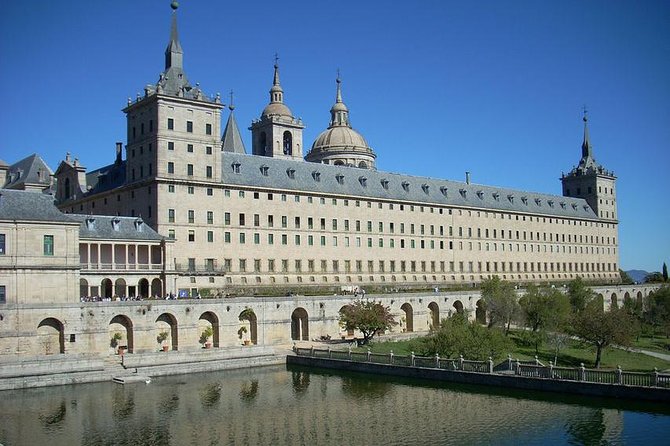
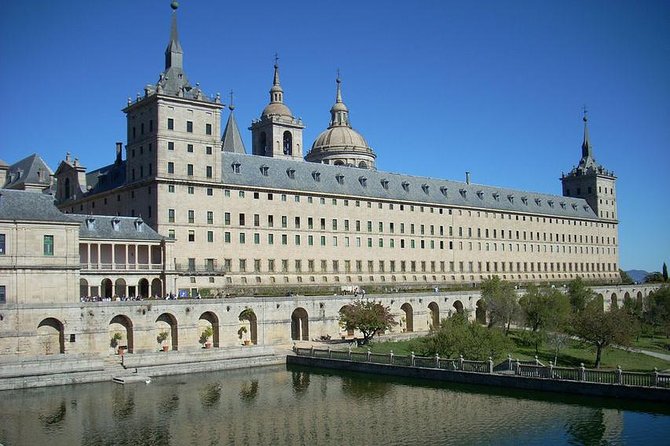
At El Escorial, you encounter the grand monastery ordered by Philip II after the Spanish victory at San Quintín in 1557. The complex served as a royal residence, monastery, mausoleum, and center of religious life. Its art collection, royal tombs, basilica, and severe architecture give you a clear picture of the power Philip II wanted to project.
At the Valley of the Fallen, the mood changes. The site was built under Francisco Franco’s regime between 1942 and 1950 as a Catholic basilica and monumental memorial. Franco described it as an act of atonement and reconciliation, but its construction also involved free workers and prisoners whose sentences were reduced through labor. That background makes this more than a scenic stop in the mountains.
I like that the two visits are paired. You see Spain’s imperial and royal past first, then confront the memory of a brutal modern conflict. If you prefer sightseeing without politics or difficult subjects, the second stop may feel uncomfortable. That discomfort is part of the point, but it is worth knowing before you book.
Other temple visits near Spain we have written up
- Montserrat Monastery Half Day Experience from Barcelona
★ 5.0 · 6,014 reviews - Montserrat Monastery Small Group or Private Tour Hotel pick-up
★ 5.0 · 5,144 reviews - Montserrat Museum and Monastery Entry Ticket
★ 4.5 · 1,740 reviews
Leaving Madrid by comfortable coach
The meeting point is Fun and Tickets on Calle de San Bernardo, 7, in central Madrid. The start time is 9 a.m., and the activity returns to the same meeting point.
The bus is air-conditioned and equipped with Wi-Fi. Several guides and drivers receive praise for making the journey smooth, and the comfortable coach matters because this trip combines two substantial visits with time on the road. Without organized transport, you would need to coordinate public transit or drive yourself to sites northwest of Madrid.
The group is listed as a maximum of 24 people. One provider response gives a figure of up to 30 for El Escorial groups, so I would not assume you are getting a tiny private outing. Either way, this is a shared tour rather than a personal guide experience.
You may receive headphones or a radio headset so you can hear the guide while walking. This system worked well for many people, but microphone and signal problems have also been reported. If the sound cuts out, tell the guide promptly instead of trying to follow from a distance.
The route reaches the southeastern side of the Sierra de Guadarrama, around 47 kilometers from Madrid. Expect cooler conditions at the sites than in the city. One useful piece of advice is simple: take a light extra layer, even if Madrid feels warm when you leave.
The Valley of the Fallen: a difficult memorial in the mountains
The first stop lasts about an hour, with admission included.
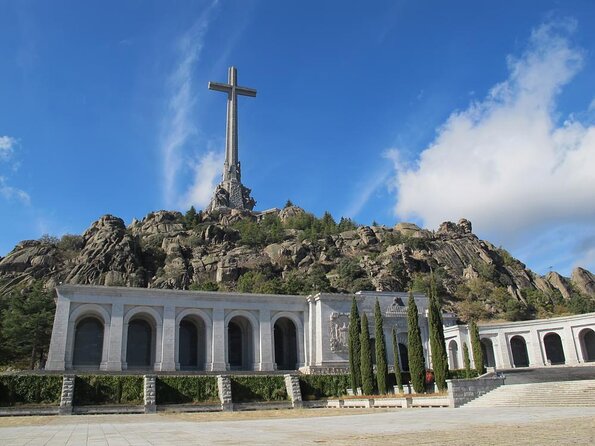
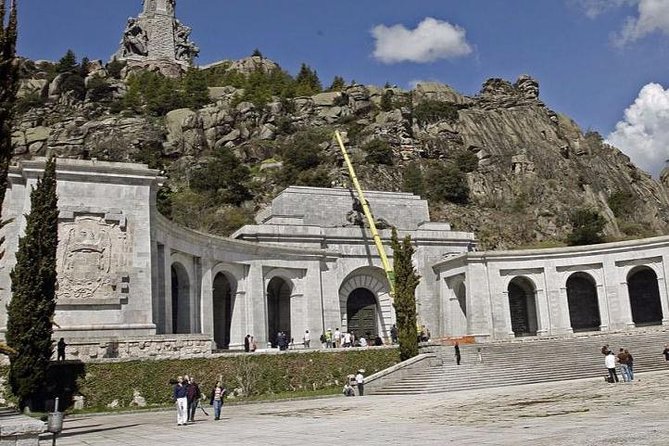
The Valley of the Fallen, now also associated with Cuelgamuros Valley, is dominated by a monumental cross and a basilica built into the mountainside. The scale is deliberately overwhelming. You are not visiting a small plaque or a quiet village church. You are entering a major political and religious monument created during Franco’s rule.
The site was intended to commemorate those who died in the Spanish Civil War, but its connection with the Franco regime makes it contested. The history of its construction adds another layer. Much of the work was done by free laborers, while a significant number of prisoners worked under a system that allowed sentence reduction.
Your guide should help place the monument in context rather than treating it as just an impressive building. Guides such as Cristina and Bea have been praised for clear explanations at both sites, while other visitors have found that the bilingual format reduced the amount of English detail available. I would listen closely here, since the significance of the place is easy to miss if you focus only on the huge cross and basilica.
An hour is enough for an introduction, but it is not a leisurely research visit. You will see the principal areas included in the tour, then move on. The timing works well if your goal is to understand why the site exists and how it fits into Spain’s history. It will feel short if you want to examine every detail or spend a long time reflecting.
Dress and behavior matter. This is a religious institution and a memorial to people who died in a cruel war. Smart-casual clothing is required, and respectful conduct is expected. You should not treat the place as a theme park or a photo stop.
El Escorial: Philip II’s severe royal masterpiece
The second visit lasts about two hours and includes admission to the monastery.
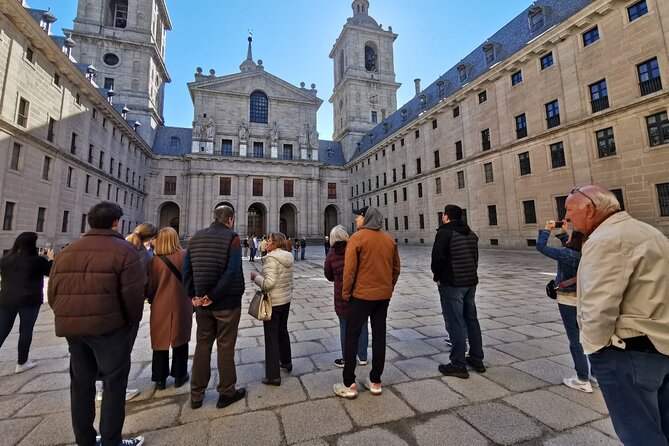
San Lorenzo de El Escorial was ordered by Philip II after the Battle of San Quintín, fought on the feast day of Saint Lawrence in 1557. Philip also wanted a mausoleum for his parents and himself, under Saint Lawrence’s protection. The result is part monastery, part palace, part church, part burial place, and part art collection.
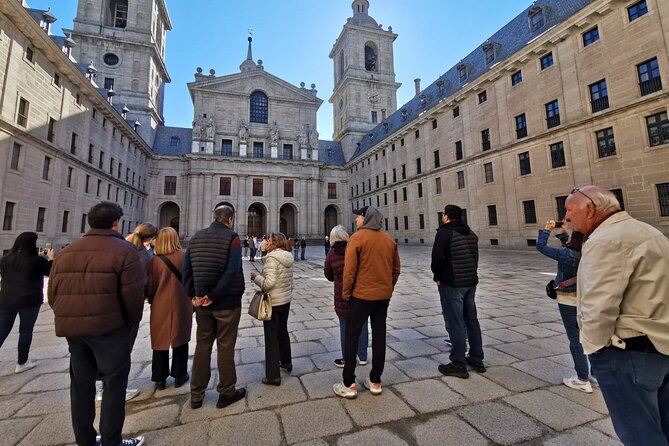
The architecture is imposing rather than playful. The complex reflects Philip II’s serious religious outlook and his role as one of Europe’s most powerful monarchs. You will see the basilica and the royal crypt, along with rooms and collections connected to the Spanish crown.
The art is a major reason to pay attention. One guide highlighted paintings of the world’s largest naval battle and the world’s first atlas among the collection’s notable features. Those details help turn the visit from a quick march through old rooms into a lesson in how Spain understood its place in the world.
I would expect a highlights tour rather than access to every corner. The monastery is enormous, and the organized visit covers selected areas. That keeps the schedule workable, but it also means you may leave wishing you had another hour. One person felt the visit did not include enough of the complex, while others found the two-hour stop well paced.
The guides make a real difference here. Cristina is repeatedly praised for her explanations of Philip II, the art, gardens, and royal history. Luis is noted for detailed historical commentary, while Oscar has been praised for a thorough presentation. Beatrice and other guides have also received strong marks for making the day easy to follow.
A different set of gates, same trip:
- Montserrat Small Group: Monastery, Black Madonna & Natural Park
★ 5.0 · 1,690 reviews - From Madrid: Escorial Monastery and the Valley of the Fallen
★ 4.7 · 1,434 reviews - Madrid: Flamenco Show at Tablao Sala Temple with Drink
★ 4.8 · 1,206 reviews - From Seville: Italica Roman City & Medieval Monastery Tour
★ 4.5 · 1,051 reviews
How the bilingual format affects the experience
The tour is offered in English, but it may be operated by a multilingual guide. If the group includes Spanish speakers, the same explanation can be delivered in both languages.
This arrangement can work well. One guide managed Spanish and English successfully, and another bilingual presentation was described as pleasant and competent. You benefit from having one guide rather than splitting the group, and the information remains consistent.
The trade-off is time. Repeating every explanation means less time for questions, walking, and quiet viewing. One person found the English section hit and miss because the group was mainly Spanish-speaking. Another felt the guide’s English was swallowed or too difficult to catch.
If clear English commentary is essential to you, ask about the language arrangement before booking. A private tour is available from the same provider, according to the information supplied, and that may suit you better if you want a single-language explanation or a slower pace.
Timing, walking, and what to carry
The whole experience lasts about five hours. That is a good length for a morning outside Madrid, but it leaves little room for wandering on your own.
You should be comfortable walking through large historic buildings and memorial grounds. A moderate physical fitness level is recommended. The information does not give a precise step count or accessibility plan, so you should contact the provider directly if stairs, distance, or mobility equipment could affect your visit.
There is no food or drink included. Take water and a small snack. The schedule is compact, and you may not have a convenient meal stop before returning to Madrid.
The weather can differ from the city. The mountain setting may be colder, particularly at the Valley of the Fallen. A jacket or warm layer is sensible, even on a sunny day. Comfortable shoes are also more useful than dress shoes, while still respecting the smart-casual dress requirement.
The tour ends back at the starting point, which is helpful if you have evening plans. Allow yourself a little flexibility after the stated return since road conditions and group timing can vary.
Is the $74.98 price good value?
At $74.98 per person, the price is reasonable if you want both sites in one morning without renting a car or piecing together public transport.
You are paying for the coach, Wi-Fi, a professional guide, entry to the Valley of the Fallen, and entry to El Escorial. Admissions alone are not the only concern. The real value is the time saved arranging the route and the historical explanation that links the two places.
I especially like the value for a first visit to Madrid. You can see two major sites that are difficult to combine on your own, then return to the city the same day. The bus also removes the stress of navigating unfamiliar roads in the Sierra de Guadarrama.
The price is less attractive if you want a slow, independent exploration. The visit to El Escorial covers only part of the vast complex, and the Valley of the Fallen receives about an hour. You may prefer separate visits if you want long museum time, extensive photography, or quiet reflection.
The strong overall score and 96 percent recommendation suggest that the basic formula works well, particularly when the guide and audio equipment perform properly. Still, I would treat those figures as a broad indication, not a promise that every departure will have the same guide or group dynamic.
Who should book this half-day trip?
I would choose this tour if you want:
- A straightforward outing from Madrid without driving
- A guide to explain Philip II, the royal tombs, art, and Civil War memory
- A useful first look at two major sites in one day
- Comfortable transport and included admission
- A shared experience at a moderate price
It suits history fans especially well. El Escorial offers royal politics, religion, architecture, and art, while the Valley of the Fallen adds modern Spanish history and a controversial memorial.
It may not suit you if you dislike fixed schedules, bilingual commentary, or large historic complexes visited at a brisk pace. It is also not the right choice if you want only cheerful sightseeing. The Valley of the Fallen carries serious political and emotional weight.
Should you book the El Escorial and Valley of the Fallen tour?
I would book it if your Madrid schedule has one free morning and you want an efficient introduction to two very different Spanish monuments. The included transport and admission make the $74.98 price fair, and guides such as Cristina, Bea, Luis, and Oscar can add much more than you would get from simply walking through the buildings.
Go with realistic expectations. You will see highlights, not every room. English may share time with Spanish, and the headset system may occasionally disappoint. Bring water, dress for cooler mountain weather, and approach the Valley of the Fallen with respect.
For most history-minded visitors, this is a worthwhile half-day. For a slower or more personal experience, choose a private option or visit the sites separately.
FAQ
How long does the tour last?
The tour lasts approximately five hours, beginning at 9 a.m. and ending back at the meeting point in central Madrid.
Where does the tour start?
It starts at Fun and Tickets, Calle de San Bernardo, 7, in Madrid’s Centro district.
Does the tour return to Madrid?
Yes. The activity ends back at the original meeting point.
Are admission tickets included?
Yes. Admission to both the Valley of the Fallen and the Escorial Monastery is included.
Is transportation included?
Yes. You travel by air-conditioned bus with Wi-Fi.
Is food included?
No. Food and drinks are not included, so you should bring water and a snack.
Is the tour offered in English?
Yes, it is offered in English. A multilingual guide may also provide commentary in Spanish when needed.
How large is the group?
The published information gives a maximum of 24 participants. A provider response also states that El Escorial groups can reach 30 people, so group size may vary.
Can I cancel for a full refund?
Yes. You can cancel at least 24 hours before the start time for a full refund. Cancellations or changes made less than 24 hours before the experience are not refunded or accepted.
Newly written up around Spain
- Barcelona: Montserrat Private Trip with Monastery Ticket★ 5.0 · 74 reviews
- Private tour: San Lorenzo de El Escorial Monastery★ 5.0 · 20 reviews
- San Lorenzo de El Escorial Monastery Private Tour★ 5.0 · 12 reviews
- San Lorenzo de El Escorial: Monastery and Site Guided Tour★ 4.8 · 127 reviews
- Semi-Private Montserrat Monastery & Hiking Experience★ 5.0 · 132 reviews
- From Palma: Serra Tramuntana and Lluc Monastery Guided Tour★ 4.5 · 146 reviews
- Full-Day Trip Barcelona to Montserrat Monastery & Cava Winery★ 5.0 · 158 reviews
- Semi-Private Montserrat Monastery, Funicular & Scenic Nature Walk★ 5.0 · 172 reviews
Madrid Temple Tours, compared.
Flamenco Show at Tablao Sala Temple with Drink
Read our review →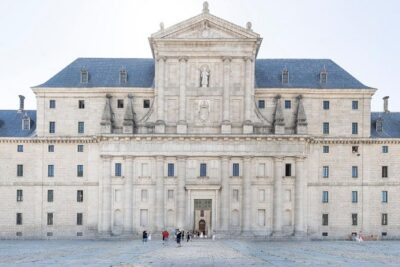
Escorial Monastery and the Valley of the Fallen from Madrid
Read our review →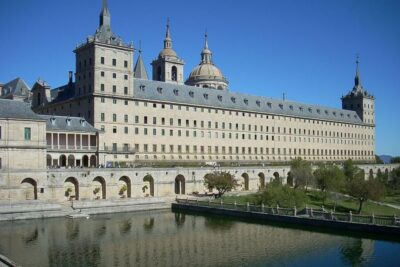
Entrance to the Flamenco Temple Room in Madrid with Tapas Option
Read our review →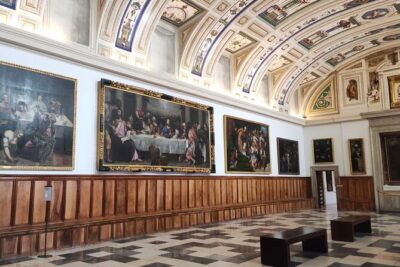
San Lorenzo de El Escorial Monastery Private Tour
Read our review →Browse the lists this tour appears in