
Reviewed · ANGKOR WAT TOURS
Full-Day Temples of Angkor Small Group Tour
Angkor is not one temple. It is a vast archaeological area spread across roughly 400 square kilometers, and this tour gives you a practical first look at its three essential monuments: Angkor Wat, Bayon, and Ta Prohm. You ride between the sites in an air-conditioned minivan, with a guide explaining the carvings, religion, rulers, and daily life behind the stones.
I like two things right away. First, the $19 tour price covers hotel pickup, transport, an English-speaking guide, drinking water, and cool towels, which makes it a strong value. Second, the small-group format can feel nearly private when only a few people book, as happened on several departures with three or five people.
The main drawback is the pace. You spend most of the day walking over uneven ground, climbing steep steps, and standing in intense heat. The $37 temple pass and lunch are also extra, so your real cost is closer to $56 before food and drinks.
Key points to know before booking
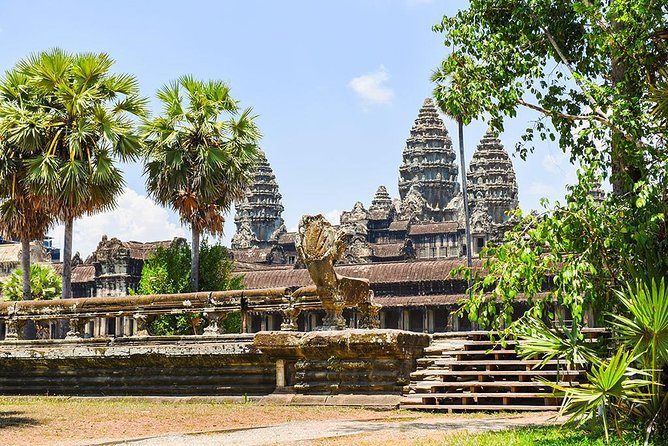
- Angkor Wat comes first, with about two hours for corridors, bas-reliefs, shrines, and the central gallery.
- Bayon and Angkor Thom provide the historical heart of the day, including the South Gate, Terrace of Elephants, and Terrace of the Leper King.
- Ta Prohm delivers the jungle atmosphere, with fig trees and vines pushing through the old stonework.
- Guides make a major difference, with guides including Saruon, Sok, Sak, Sarak, Chhay, Sam, and Yuth praised for clear explanations and friendly service.
- Cold water and wet towels are supplied, a small comfort that matters greatly in Cambodia’s heat.
- The $37 entrance pass is not included, and lunch at a local restaurant near Srah Srang is also paid separately.
What this Angkor tour is really designed to do
This is a highlights tour, not a complete survey of Angkor. That distinction matters. The archaeological area contains far more than you can see in one day, so the route focuses on the places most first-time visitors want to understand and photograph.
You begin with hotel pickup in Siem Reap and travel in an air-conditioned minivan. The listed duration is about eight hours, though the exact schedule depends on the departure. Several departures began around 4:30 a.m. for sunrise and finished around noon, while the advertised itinerary includes lunch and a longer full-day format. I would confirm your pickup and expected return time before booking.
The vehicle is one of the tour’s practical strengths. You walk through hot temple ruins, then return to shade, cold water, and a cool wet towel. That cycle makes a long day easier, especially in the hotter months.
The group size can reach 15 people, but it may be much smaller. A group of three or five allows you to ask more questions and stay closer to your guide. A full group will require a little more patience at stairs, doorways, and photo stops.
More Angkor Wat Tours in Siem Reap:
- Angkor Wat Sunrise or Sunset Tour with Guide from Siem Reap
★ 5.0 · 12,109 reviews - Siem Reap: Angkor Wat: Small-Group Sunrise or Sunset Tour
★ 5.0 · 9,444 reviews - Siem Reap: Angkor Wat 2-Day Tour with Sunrise and Sunset
★ 4.9 · 4,429 reviews
Angkor Wat: two hours inside Cambodia’s great monument
Angkor Wat is the obvious opening stop, and the tour gives it roughly two hours. That is enough time for a useful introduction, though not enough to inspect every carving or wander every outer section.
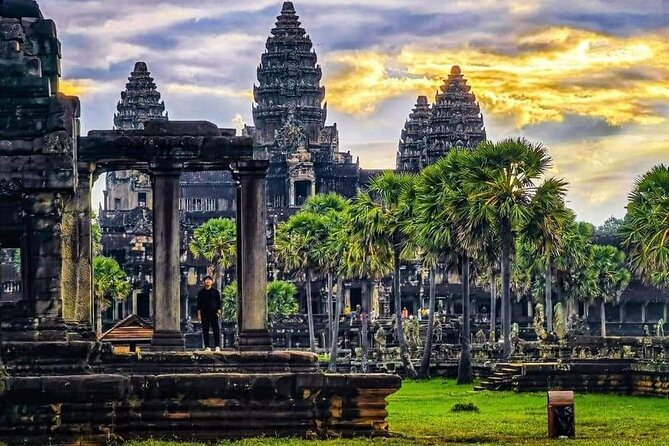
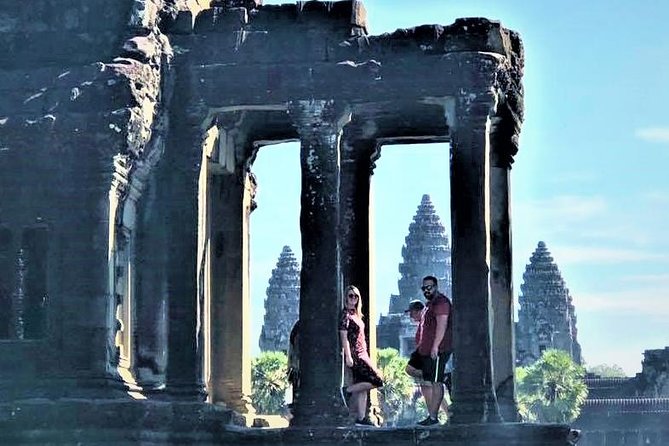
As you approach, your guide can set the scene: Angkor Wat was built as a Hindu temple dedicated to Vishnu and later became a Buddhist place of worship. You will see both traditions reflected in the site, including statues tended by local monks and religious activity that continues today.
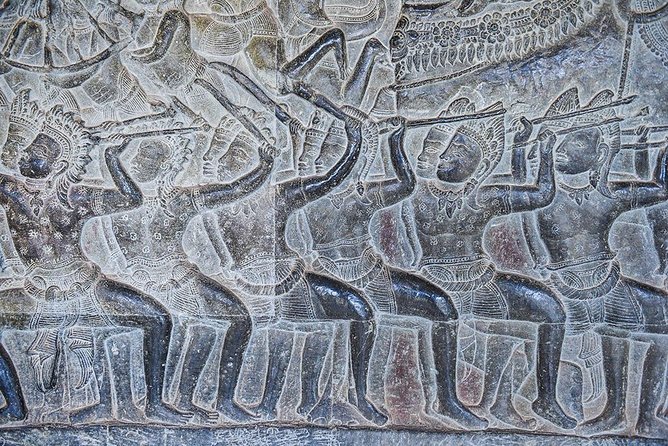
The temple is best understood as a series of transitions. You move from broad outer spaces into long stone passageways, then toward galleries covered with bas-reliefs. The carvings are not random decoration. They show battles, religious scenes, royal power, and stories from Hindu tradition.
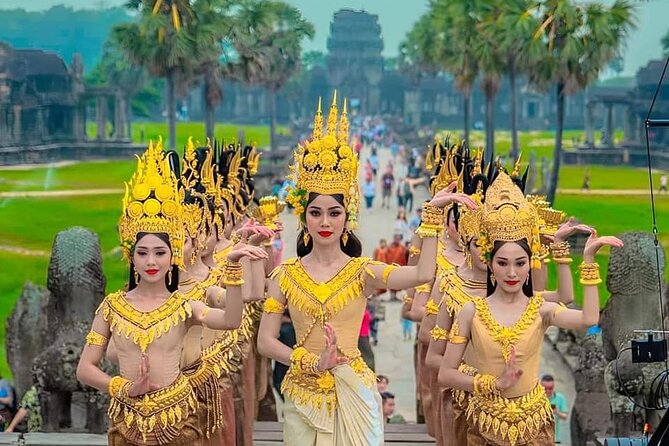
Inside, look up for the carved apsaras, the celestial dancers repeated across the galleries. Their poses and details reward a slower look, but the crowds and the heat can make that difficult. Your guide can point out features that are easy to miss when you are focused on getting a photograph.
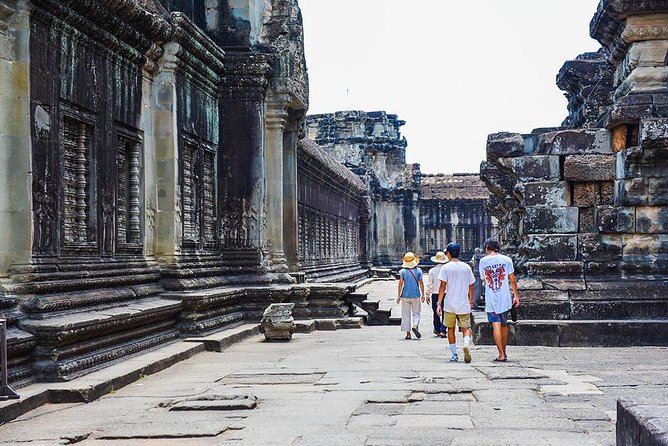
The upper levels involve steep stairs and considerable effort. You should wear proper walking shoes and expect some up-and-down movement even before reaching the central gallery. The experience is rewarding, but it is not a gentle stroll through a museum.
Some departures begin before dawn so you can watch sunrise over Angkor Wat. That requires a very early pickup, commonly around 4:30 a.m., but it gives you a memorable start and helps you reach the temple before the day becomes brutally hot. If sunrise matters to you, confirm that your specific departure includes it rather than assuming every tour follows the same timing.
Angkor Thom South Gate and the road into the old capital
After Angkor Wat, the route continues to Angkor Thom, once the capital of the Khmer Empire. The South Gate is a short stop of about 30 minutes, but it gives you one of the clearest visual introductions to the city.
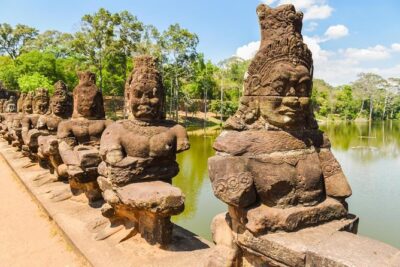
The approach is lined with 108 stone figures. On one side are gods with calmer faces. On the other are demons with more severe expressions. Together they represent the famous Churning of the Ocean of Milk, a Hindu story about the struggle between opposing forces.
The bridge creates a dramatic entrance, but it also becomes a busy photo area. Stay alert to the traffic and give yourself a moment to look at the statues rather than rushing straight toward the gate. Their damaged bodies and weathered faces show the age of the complex, while the repeated arrangement gives the entrance a strong sense of order.
This is a good point to listen closely to your guide. The gate is easy to photograph in a few minutes, but its meaning is less obvious without an explanation of the figures and the city they guarded.
Bayon Temple and the calm faces in the stone
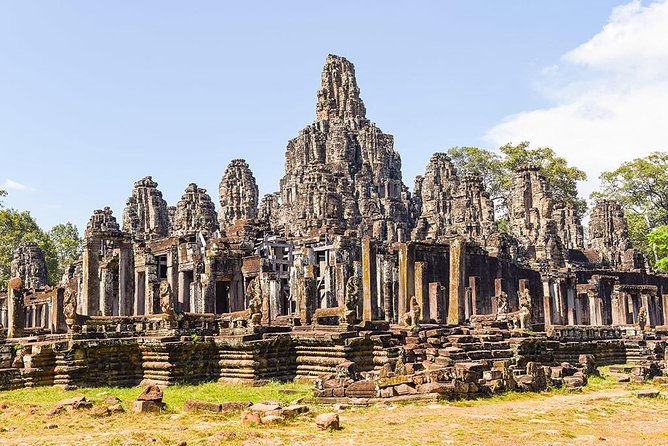
Bayon is scheduled for about 90 minutes, and I consider this one of the most valuable parts of the tour. It is unlike Angkor Wat. Instead of long open galleries and a broad central composition, Bayon feels compressed, layered, and slightly confusing in the best possible way.
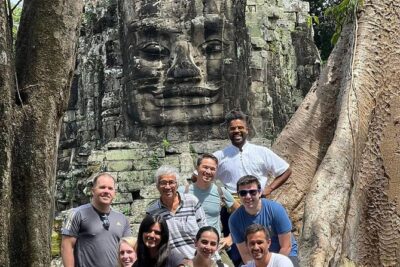
The temple is famous for its enormous carved faces, often identified with the bodhisattva Avalokiteshvara and associated with King Jayavarman VII. The faces look out from towers above the narrow passages, creating the impression that the temple is watching you as you move through it.
The lower galleries contain bas-reliefs showing war, ceremonies, markets, boats, animals, and ordinary scenes. The carvings of Khmer victories against Cham forces are important, but the everyday details can be just as interesting. Look for hints of cooking, trade, dress, and village life among the royal images.
Bayon has plenty of uneven stone and stairs. You will be moving through narrow areas where the group may bunch up. A good guide keeps the explanations moving while allowing time for photographs. Guides such as Sarak, Chhay, and Sok have been praised for clear English and for explaining the stories behind the stone carvings.
More Full-Day Tours in Siem Reap:
- Siem Reap: Full-Day Angkor Wat Guided Tour with Sunset
★ 4.9 · 3,803 reviews - Full-Day Angkor Wat Sunrise Private Tour with Guide from Siem Reap
★ 5.0 · 2,920 reviews - Siem Reap: Angkor Wat Sunrise and Full-Day Sightseeing Tour
★ 4.9 · 2,828 reviews - Full-Day Guided Sunset Tour of Angkor Wat
★ 5.0 · 1,507 reviews
The Terrace of Elephants and Terrace of the Leper King
The route passes by the Terrace of Elephants and the Terrace of the Leper King rather than treating them as long separate visits. That is sensible for a one-day highlights tour, but it means you should not expect an extended exploration of both terraces.
The Terrace of Elephants served as a ceremonial viewing platform. Its long stone frontage includes elephant imagery and connects with the grand public side of Angkor Thom. The Terrace of the Leper King has more intricate carvings and a maze of figures in the inner walls.
These stops help you understand that Angkor Thom was more than a collection of temples. It was a royal city with processions, ceremonies, public spaces, and political power. Your guide’s explanation is particularly useful here because the terraces can look like low walls until you understand how they functioned.
Lunch near Srah Srang, with the bill kept separate
The planned lunch stop is near Srah Srang, a large reservoir associated with the Angkor complex. You receive about an hour to eat and rest at a local Khmer restaurant. Lunch is not included, so you pay for your own meal and drinks.
This break is important less for sightseeing than for recovery. By this point, you have already walked through Angkor Wat and Bayon, and the heat can begin to catch up with you. Use the hour to sit down, drink water, and cool off rather than treating it as another rushed stop.
Some groups have eaten in a clean, air-conditioned room, while another departure described the restaurant as decent and fairly priced. I would still regard the meal as a practical stop, not a central reason to book the tour. Bring some Cambodian riel or a payment method suitable for the restaurant, and remember that the tour price does not cover food.
Ta Prohm: vines, fallen stones, and the Tomb Raider effect
Ta Prohm is the final major temple, with about 90 minutes to explore. This is the atmospheric stop, where trees and vines grow over, through, and around the ruins.
The temple is widely known as the Tomb Raider temple, but the movie connection is only part of its appeal. Ta Prohm shows the tension between preservation and nature. Walls have been stabilized, yet enormous fig trees still push through the stonework. Corridors open into courtyards, then narrow again into shadowed chambers.
You will find plenty of uneven paths and stairs. The site can feel more difficult late in the day, when you are tired and the heat has built up. Good footwear matters here, and you should not plan on moving quickly through every section.
Ta Prohm is also one of the better places to appreciate why a guide adds value. A guide can explain which areas were religious spaces, point out architectural details, and help you find sensible photo positions without turning the visit into a hunt for one famous movie angle.
Guides are the make-or-break part of the day
The temples are extraordinary, but the quality of your day depends heavily on the guide assigned to your group. The company uses several guides, so you cannot necessarily request one person unless that is arranged separately.
Names praised in the supplied experience details include Saruon, Sok, Sak, Sarak, Chhay, Sam, Yuth, Kiss, Chansarak, and Sopheaprath. The strongest pattern is clear: guests value guides who explain the religious symbolism, Khmer history, temple carvings, and local culture in understandable English.
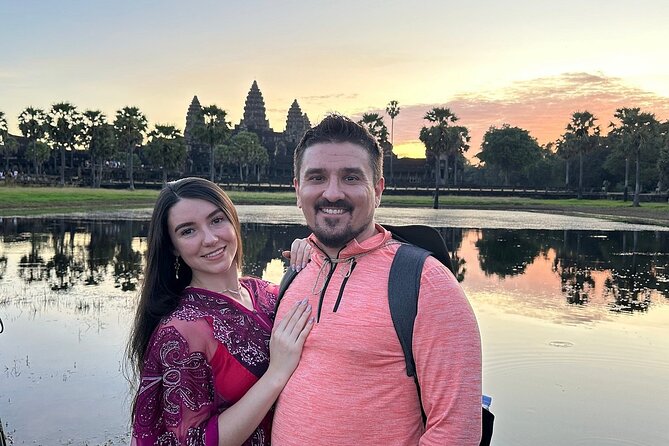
Several guides also helped with photographs. That is a useful service for couples and solo visitors who want more than self-portraits. Guides were also described as patient, attentive, and willing to answer questions, which is especially helpful at Bayon and Angkor Wat, where a quick look can leave you with more questions than answers.
English ability may vary by guide. One description specifically noted that the guide was kind and helpful but still working on his English. If detailed historical explanation is your main reason for booking, keep your questions direct and ask the guide to repeat or clarify anything important.
Transport, water, clothing, and the heat
The air-conditioned minivan is included, along with mineral water and cool towels. You return to the vehicle between major stops, which gives you a chance to cool down before walking again.
Still, do not treat the supplied water as your entire heat plan. Bring sun protection, a hat, sunscreen, and additional drinking water if you need it. One departure reached 42 degrees Celsius, and the combination of humidity, stairs, and exposed stone can be tiring.
Wear comfortable walking shoes with a firm sole. Sandals may be acceptable for some visitors, but they are less useful on rough paths and stairs. You also need clothing that covers your shoulders and knees. A scarf over bare shoulders is not accepted as a substitute, so dress properly before pickup.
The minimum age is five. Most people can take part, but the tour involves a large amount of walking and climbing. If you tire easily, use the vehicle breaks well and tell your guide when you need a pause.
What the $19 price really buys you
At $19 per person, the tour is inexpensive for an eight-hour guided outing with hotel transport. Add the $37 temple pass and you are at $56 before lunch and beverages. That is the more realistic budget figure.
The temple ticket is paid directly at the site and can be purchased on the day. Visa cards are accepted. Because the pass is separate, you keep some control over the final cost, but you should budget for it in advance so the low advertised tour price does not surprise you.
The value is strongest if you want structure, historical context, and transport between the temples. Hiring separate transport may give you more freedom, but you would need to arrange your own route and would not automatically have a guide explaining the carvings and religious meaning.
The small group also helps. If the group is only three or five people, you may receive attention close to a private tour without paying a private-tour rate. If all 15 places are filled, the price remains good, but the experience will feel less personal.
Who should book this tour?
I would choose this tour for a first visit to Angkor when you want to see the main monuments in one organized day. It suits couples, families with children aged five or older, solo visitors, and anyone who prefers not to negotiate transport or study the temple layout alone.
It is also useful if you have only one full day in Siem Reap. Angkor deserves more time, but this route gives you a solid foundation. You see the great scale of Angkor Wat, the royal setting of Angkor Thom, the faces of Bayon, and the trees of Ta Prohm.
I would think twice if you dislike early starts, long walks, steep steps, or fixed schedules. The tour covers a lot, and you will not have the freedom to linger at one temple for half a day. Visitors who want quiet photography or obscure ruins should consider a slower, more specialized plan.
Should you book the Full-Day Temples of Angkor tour?
Yes, if your priority is high value and the essential Angkor route. The $19 base price is hard to fault when it includes hotel pickup, transport, a guide, water, and cool towels. The best guides, including Saruon, Sok, Sak, Sarak, and Yuth, can turn a procession of ancient stones into a clear story about Khmer kings, religion, art, and daily life.
Book it with realistic expectations. Your total spend will be higher after the $37 temple pass and lunch. The day can be exhausting, the group may be larger than expected, and the schedule may vary between a sunrise-focused departure and a longer version with lunch.
If you prepare for heat, wear proper clothing, and accept the brisk pace, this is a sensible first introduction to Angkor. It gives you the big three temples, useful historical context, and the comfort of returning to a cool vehicle between long walks.
FAQ
How long does the Angkor small-group tour last?
The advertised duration is approximately eight hours. Some departures begin around 4:30 a.m. for sunrise and have finished around noon, so confirm the exact pickup and return schedule for your date.
Is hotel pickup included?
Yes. Pickup and drop-off at your Siem Reap hotel are included.
Is the Angkor temple entrance fee included?
No. The temple pass costs $37 per person and must be paid directly at the site. Visa cards are accepted, and the pass can be purchased on the day of the tour.
Is lunch included?
No. The itinerary includes a lunch stop near Srah Srang, but food and beverages are paid separately.
What temples are visited?
The main stops are Angkor Wat, Angkor Thom South Gate, Bayon Temple, Srah Srang for the lunch break, and Ta Prohm. The tour also passes the Terrace of the Leper King and the Terrace of Elephants.
How large is the tour group?
The maximum group size is 15 people. Some departures may be much smaller, with groups of three or five reported in the supplied experience details.
What should I wear?
You must cover your shoulders and knees. A scarf used to cover bare shoulders is not accepted, so wear suitable clothing from the start. Comfortable walking shoes are strongly recommended.
Is the tour suitable for children?
The minimum age is five. Most people can participate, but you should be ready for extensive walking, stairs, uneven surfaces, and hot weather.
What does the tour include besides transport and a guide?
The tour includes an English-speaking licensed guide, an air-conditioned minivan, mineral water, cool towels, hotel pickup and drop-off, and local tax. Food, beverages, and the temple pass are not included.
Newly written up around Siem Reap
- Siem Reap: Angkor Wat Private Tour by Tuk-Tuk★ 4.5 · 117 reviews
- Phnom Kulen Waterfall and Banteay Srei Temple Tour from Siem Reap★ 5.0 · 30 reviews
- 5-Day All Major Temples & Kulen Mount Waterfall & Koh Ker & Beng Mealea★ 5.0 · 13 reviews
- 3-Day Angkor Wat & All Interesting Major Temples & Kulen Mount Waterfall★ 5.0 · 63 reviews
- Angkor Wat Tour Deutsch | Private Führung★ 5.0 · 134 reviews
- Full day exclusive tour for the main temples in Siem Reap★ 5.0 · 135 reviews
- Small-Group Full Day Angkor wat Guide tour with Sun set★ 5.0 · 136 reviews
- Angkor Wat Private Tour by Tuk-Tuk with English Speaking Driver★ 5.0 · 142 reviews
Angkor Wat Tours, compared.
Angkor Wat Sunrise or Sunset Tour with Guide from Siem Reap
Read our review →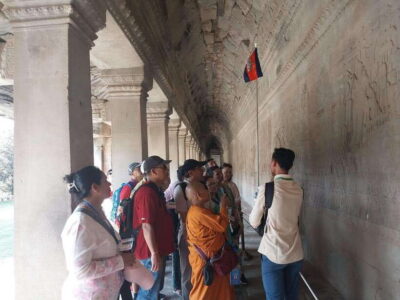
Angkor Wat: Small-Group Sunrise or Sunset Tour
Read our review →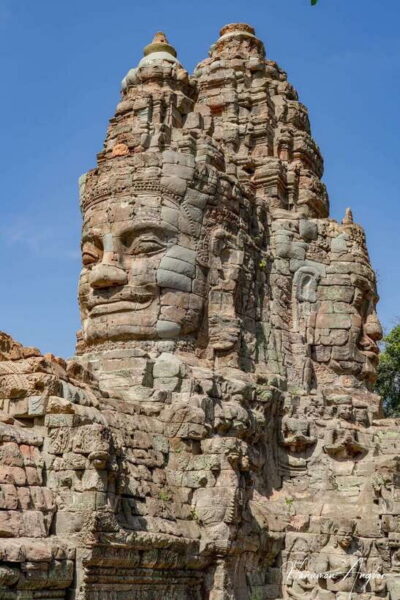
Angkor Wat 2-Day Tour with Sunrise and Sunset
Read our review →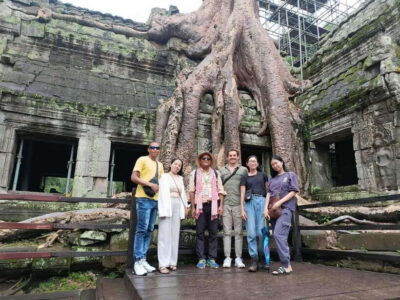
Angkor Wat Sunrise tour with Small – Group and Guide tours
Read our review →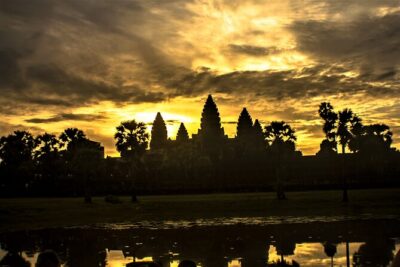
Angkor Wat Highlights and Sunrise Guided Tour from Siem Reap
Read our review →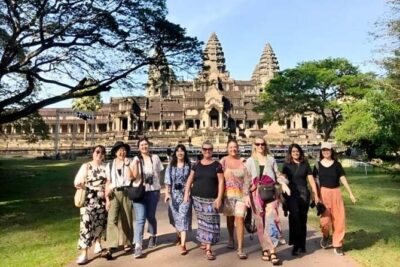
Angkor Wat Sunset Small Group Tour with Lunch Included
Read our review →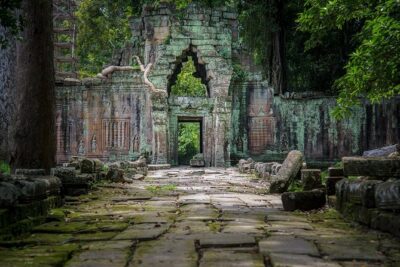
Full-Day Angkor Wat Sunrise Private Tour with Guide from Siem Reap
Read our review →Browse the lists this tour appears in