
Reviewed · VALLEY OF THE TEMPLES TOURS
Paestum Tour: Best Preserved Temples in the World (UNESCO)
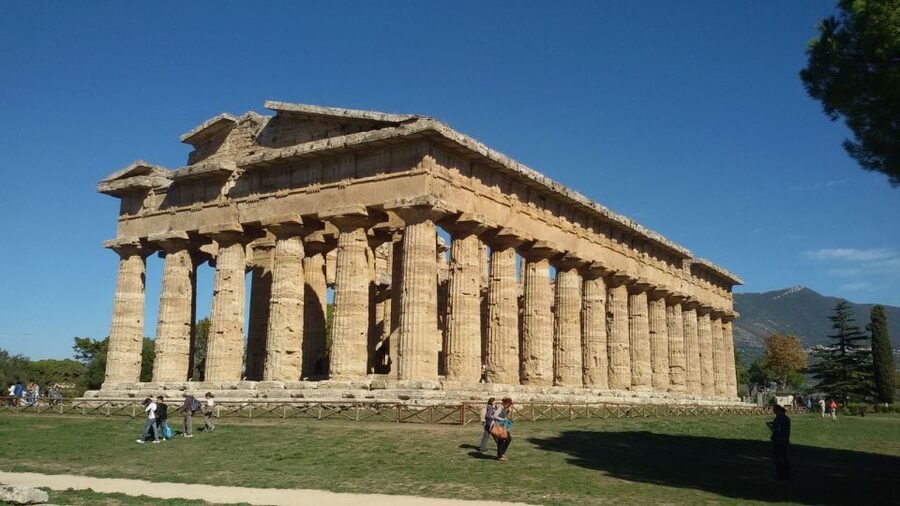
Paestum gives you something rare in Italy: three Greek temples that remain remarkably complete, set within an ancient city later used by Rome. The Temple of Poseidon is the big prize, but the older Temple of Hera and the smaller Temple of Ceres make the site feel like a full chapter of Greek architecture, not a single grand ruin.
I like the way this tour joins the outdoor ruins to the Archaeological Museum. I also like the private group format, since you can ask questions and keep the pace focused on what interests you. The main drawback is practical: the $325.13 price covers the group and guide, but not entrance tickets, food, or transportation. It is strong value for a larger private group, less so for just one or two people.
Key points to know before booking
- Three major Greek temples: See the temples of Hera, Poseidon, and Ceres, with the Temple of Poseidon as the largest and most imposing.
- A museum visit is included in the guiding: The route ends with the Tomb of the Diver, painted metopes, a statue of Zeus, and other finds.
- Two hours goes quickly: You will cover the central highlights, but this is not an all-day archaeological study.
- Private groups can include up to 25 people: The fixed group price makes more sense when shared among several people.
- Tickets are extra: You must pay separately for entry to the archaeological park and museum.
- Five guide languages are offered: You can request English, Spanish, French, German, or Italian when checking availability.
Why Paestum is worth the trip
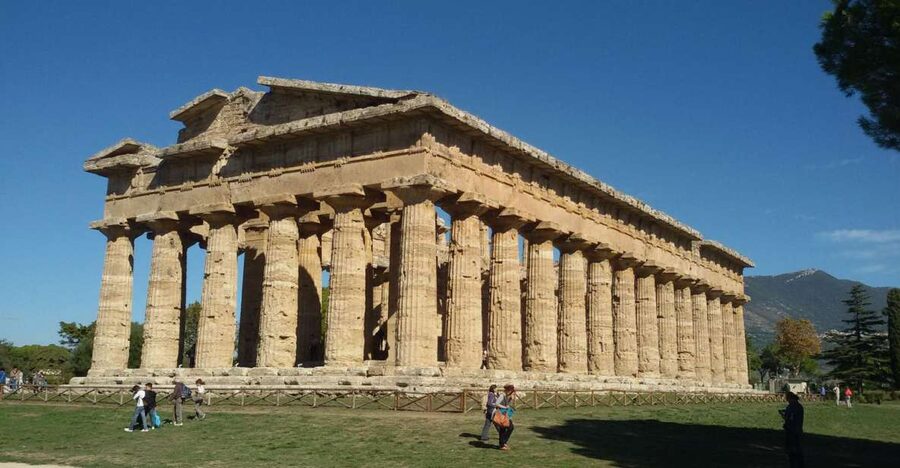
Paestum was founded as Poseidonia by Greek settlers in Magna Graecia, the Greek-influenced part of southern Italy. The Romans later renamed it Paestum and honored Poseidon, although the city also had strong ties to Athena and Hera.
That background matters because Paestum is not just a collection of broken columns. You are looking at a Greek city that continued under Roman rule, with religious buildings, public spaces, roads, and later changes layered across the same ground.
The archaeological park gives you room to understand that city plan. Instead of seeing one isolated temple and moving on, you follow the remains of sacred and civic life. The Via Sacra connects key areas, while the Roman forum and amphitheater show how the settlement changed after the Greek period.
I find the setting especially useful for understanding scale. Books and photographs can make ancient temples look flat and distant. Here, the columns and massive stone blocks show how much labor, planning, and engineering went into each building.
More Valley of the Temples Tours in Italy:
- Agrigento: Valley of the Temples Skip-the-Line Sunset Tour
★ 4.5 · 1,512 reviews - Palermo: Agrigento and the Valley of the Temples Day Tour
★ 4.2 · 1,240 reviews - Agrigento: Valley of the Temples Ticket & App Audioguide
★ 4.3 · 1,160 reviews
Starting at the museum entrance
The meeting point is the entrance to the Archaeological Museum in Paestum. This is also where the tour ends, so you do not need to arrange a separate return point.
A licensed guide leads the private group through both the outdoor park and museum. The guide is available in English, Spanish, French, German, or Italian. Since no individual guide name is provided, you should confirm the language and starting time when you book.
The two-hour length gives the visit a clear shape. You are not left to wander without direction, and the guide can explain why each building matters as you reach it. At the same time, you should keep your expectations realistic. Three temples, the Roman remains, and the museum are a lot to cover in 120 minutes.
If you like to stop often for long photographs or detailed questions, you may need to choose your priorities. A private group helps here because the guide can respond to your interests instead of following the needs of a large mixed crowd.
The Temple of Hera, Paestum’s oldest major temple
The first temple is dedicated to Hera and is also called the Basilica. It is the oldest of the three temples highlighted on the tour and follows the Doric style.
Its dimensions are impressive: about 26 meters wide and 55 meters long. Those measurements are easier to appreciate when you are close to the structure, where the columns give you a real sense of its width and length.
The name Basilica can confuse modern visitors. In this setting, it does not refer to a Christian church. The label comes from an earlier interpretation of the building. The tour gives you a chance to see the temple as part of the Greek sacred area rather than judging it by later religious terms.
This stop rewards careful looking. The building is less immediately grand than the Temple of Poseidon, but its age and surviving form make it important. I like beginning here because it gives you a reference point for the temples that follow.
Your guide can also explain Doric features as you look at the columns and overall shape. The architecture is easier to follow when you can connect the names and proportions to actual stone in front of you.
The Temple of Poseidon, the great Paestum view
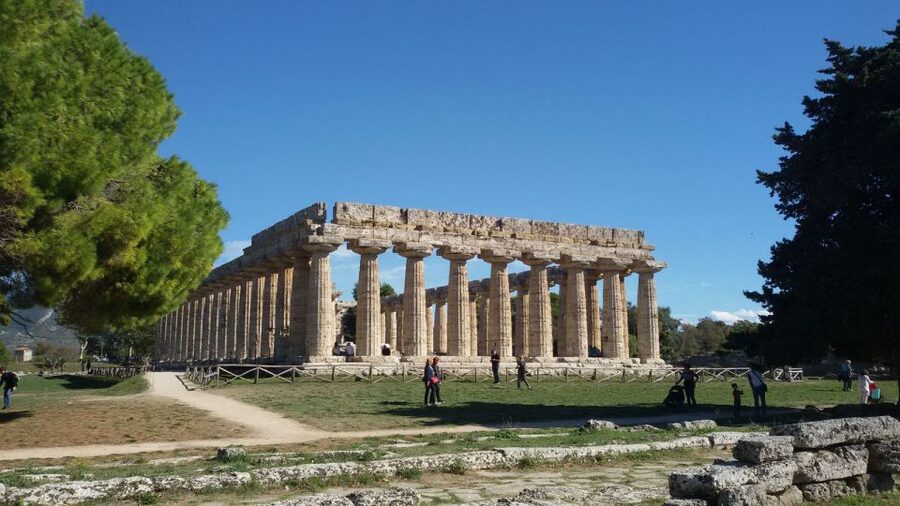
The largest temple on the route is dedicated to Poseidon and is also called the Temple of Neptune. It was built around 460 BCE in the Doric style and is compared with the Temple of Zeus at Olympia.
This is the moment when Paestum usually clicks. The size is not only impressive from a distance. The heavy columns, broad platform, and surviving arrangement show why Greek temples were designed to project order and strength.
The guide’s explanations are particularly useful here because the building can be hard to read on your own. You can look at rows of columns and admire the view, but a good explanation helps you notice proportions, construction choices, and the relationship between the temple and the surrounding sanctuary.
The tour does not promise entry into the temples, and the supplied details describe admiration of the structures from the archaeological park. You should therefore think of this as an architectural and historical visit, not an activity involving climbing or interior rooms.
Allow yourself a moment to look without taking notes. Paestum’s power comes partly from its physical presence. A guide supplies the context, but the stone does much of the talking.
Other temple visits near Italy we have written up
- Pantheon Elite Guided Tour – Rome’s Iconic Ancient Temple
★ 5.0 · 1,447 reviews - Rome’s Iconic Temple: Pantheon Audio Guided Tour with Fast Access
★ 4.0 · 1,188 reviews - Colosseum Special Access Tour, with Ancient Temples & Tombs
★ 4.8 · 747 reviews - Agrigento: Valley of the Temples E-Scooter Tour
★ 4.6 · 557 reviews
The Temple of Ceres and the sanctuary of Athena
The third temple is called the Temple of Ceres and is identified as a sanctuary dedicated to Athena. It is smaller than the Temple of Poseidon, but the reduced scale does not make it unimportant.
This stop helps you compare different types of sacred buildings within the same ancient city. After the huge Temple of Poseidon, the more modest proportions of the Temple of Ceres give the route some balance.
I like having this comparison built into the visit. You can see that Paestum was not organized around one single monument. Different sanctuaries served different purposes, and the city’s religious life had several focal points.
The guide can help sort out the names, since the building’s traditional name and its association with Athena do not line up as simply as a modern label might suggest. This is exactly the kind of point that is easy to miss when you visit independently.
The Via Sacra, Roman forum, and amphitheater
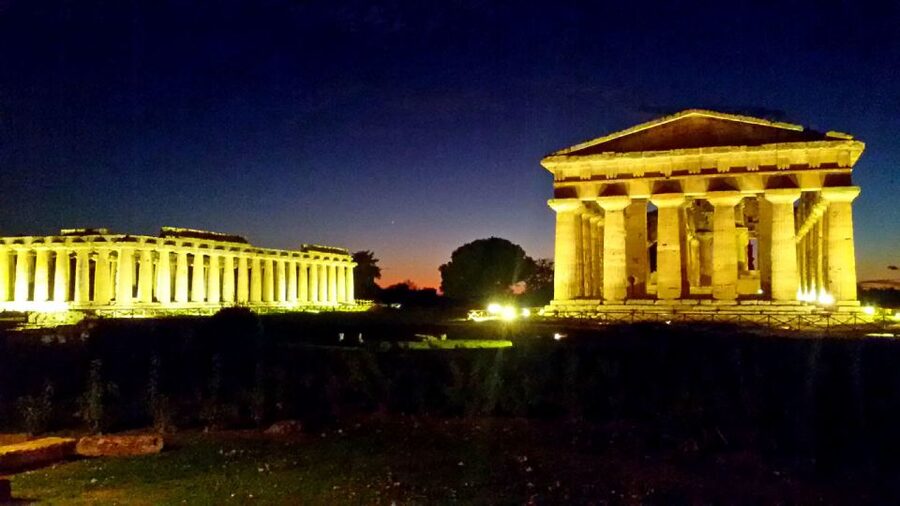
After the temples, the tour follows the Via Sacra and continues into the Roman parts of Paestum. The Roman forum and amphitheater add a second period to the visit.
The forum was a central public space, while the amphitheater points to the entertainment and civic life of the Roman city. Together, they keep Paestum from becoming only a Greek temple stop.
The Roman remains may not have the same visual impact as the three temples. That is normal. Their value is in showing how the city was adapted over time. You see the ancient settlement as a working place, not just a sacred site preserved for modern eyes.
The route also helps you understand why a guide can be useful. A scattered field of foundations, roads, and stone outlines can be difficult to interpret without a plan. Explanations turn those remains into part of a city.
Since the full experience lasts two hours, the Roman forum and amphitheater will be covered as highlights rather than as an exhaustive survey. If Roman urban planning is your main interest, ask the guide to spend more time there.
The Archaeological Museum and the Tomb of the Diver
The final stop is the National Archaeological Museum, where the outdoor remains gain more human detail.
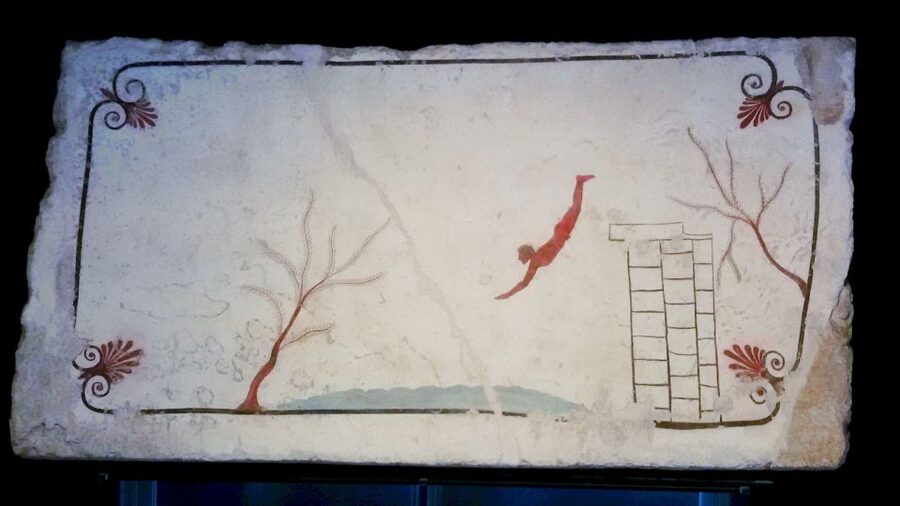
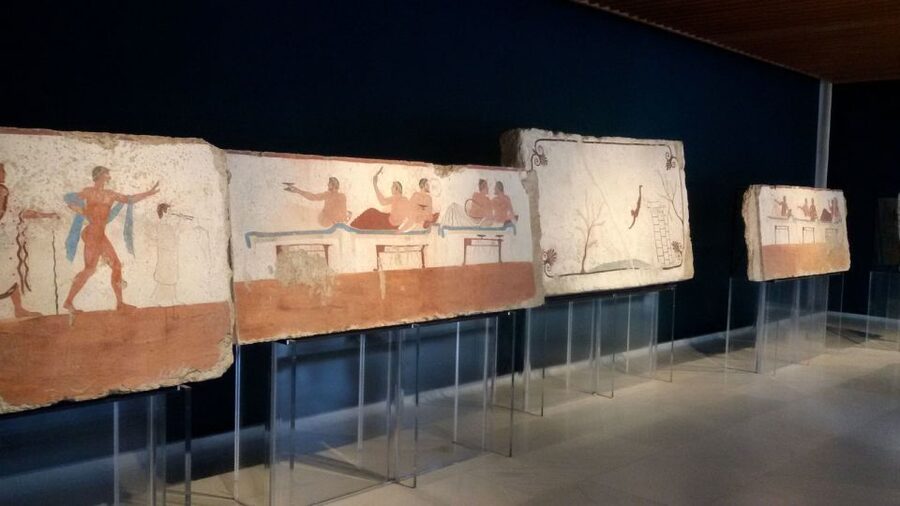
One of the major displays is the Tomb of the Diver. The tomb consists of five limestone slabs made from local travertine, covered with plaster and decorated with figurative wall paintings using the fresco technique.
The painted scene is famous because it shows a diver. Its subject is unusual and gives the tomb a personal quality that monumental temples do not always provide. After looking at huge religious buildings, you finish with a small burial chamber that tells you something about death, symbolism, and artistic expression.
The museum also contains 33 metopes from the Temple of Hera Argiva. These architectural panels help you connect museum objects with the buildings you have just seen outside.
Other listed highlights include a statue of Zeus and a krater depicting the abduction of Europa. These pieces broaden the visit beyond architecture. You are not only looking at columns and foundations. You are also seeing sculpture, painted decoration, and objects linked to Greek religious and artistic traditions.
Ending inside the museum is a smart part of the route. The outdoor ruins can leave you with big visual impressions, while the artifacts provide smaller details. Together, the two settings make Paestum easier to understand.
What the two-hour format really gives you
Two hours is enough for a focused first visit. You can see the three temples, the main Roman remains, and the museum highlights without spending time deciding where to go next.
It is not enough for an unhurried study of every building, inscription, and museum case. You will want to keep moving, especially if your group asks many questions or pauses for photographs.
The private format is the key advantage. The group can include up to 25 people, but it remains your own group rather than a large public tour. The fixed price of $325.13 is therefore best judged by group size.
For 20 to 25 people, the cost can be reasonable because the guide fee is shared. For a couple, it becomes a premium experience. You are paying for a dedicated licensed guide and a planned route, not for an inexpensive entry ticket.
Entrance tickets to the Archaeological Park and National Archaeological Museum are not included. You should add those costs to your budget before comparing this tour with other Paestum options. Transportation, pickup, drop-off, and meals are also not included.
Who will get the most from this tour
I would choose this tour if you want the main story of Paestum explained clearly and you prefer a private guide to an audio guide or self-guided visit.
It is a good fit for:
- Families or friends who want to share one guide and divide the fixed fee.
- First-time visitors who want the temples and museum connected in one route.
- Architecture fans interested in Doric temples and Greek building design.
- People who want to ask questions in English, Spanish, French, German, or Italian.
- Anyone who prefers a short, organized visit rather than several hours of independent exploration.
It may be less suitable if you want a full-day archaeological study, transport from your hotel, or a package that includes admission and lunch. You will need to arrange those parts yourself.
The available rating is 4.5 out of 5 from 11 reviews. The clearest praise focuses on the explanations of architecture and history, the guide’s ability to answer questions, and the friendly, rewarding exchanges during the visit. That matches the strongest reason to book: this experience is about interpretation, not just access to the ruins.
Practical booking advice
Check the available starting times before building your day around Paestum. The activity lasts two hours and begins at the Archaeological Museum entrance, ending at the same point.
Reserve only after checking the guide language you want. English, Spanish, French, German, and Italian are listed, but availability can depend on the selected time.
You can cancel up to 24 hours in advance for a full refund, and the reserve-now-pay-later option lets you hold the booking without paying immediately. Those policies help if your Campania plans are still changing.
Bring a plan for the rest of your day. The tour does not include transportation, pickup, drop-off, tasting, lunch, or dinner. The experience provider is Italygonia Travel T.O., and the activity is operated as a private group tour.
Should you book the Paestum tour?
Book it if you want a focused two-hour introduction led by a licensed guide who can connect Greek temples, Roman public buildings, and museum objects into one story.
The best value comes when several people share the $325.13 group price. The experience is less appealing for a solo visitor or couple on a tight budget, especially because entrance tickets are extra.
For most first visits, I like the balance: the Temple of Hera, the Temple of Poseidon, the Temple of Ceres, the Roman forum, amphitheater, and Tomb of the Diver all make the cut. Just remember that Paestum deserves time to look closely, so book this tour for structure and context, not for a slow, exhaustive study of every ruin.
FAQ
Where does the Paestum tour begin?
The tour begins at the entrance to the Archaeological Museum in Paestum.
Where does the tour end?
The activity ends back at the meeting point, at the Archaeological Museum entrance.
How long does the guided tour last?
The tour lasts two hours. Starting times depend on availability.
What languages are available?
A live guide is available in English, Spanish, French, German, and Italian.
Is this a private tour?
Yes. It is offered as a private group tour for up to 25 people.
Are entrance tickets included?
No. Tickets for the Archaeological Park and National Archaeological Museum are not included in the tour price.
What is included in the price?
A licensed guide is included. Transportation, pickup and drop-off, entrance tickets, tasting, lunch, and dinner are not included.
Newly written up around Italy
- Padre Pio’s Shrine in San Giovanni Rotondo from Bari (Apulia)★ 5.0 · 3 reviews
- Cooking Class in a former Artist Monastery in the Heart of Monopoli★ 5.0 · 18 reviews
- Agrigento Valley of the Temples Archaeological Area★ 4.0 · 33 reviews
- Agrigento to Siracusa with Valley of Temples and Roman Villa Trip★ 5.0 · 5 reviews
- Agrigento: Valley of the Temples Entry Ticket & Audio Guide★ 3.0 · 40 reviews
- Private transportation to the Valley of the Temples + Agrigento★ 5.0 · 8 reviews
- Rome: Temples, Squares & Markets Guided Walking Tour★ 4.8 · 26 reviews
- Rome underground hidden temples, ruins, and secret basilicas★ 3.7 · 21 reviews
Valley of the Temples Tours, compared.
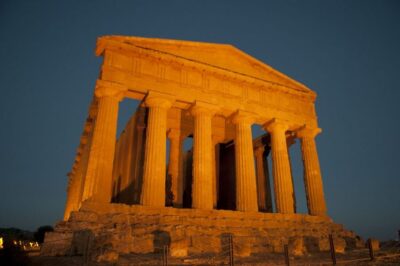
Valley of the Temples Skip-the-Line Sunset Tour
Read our review →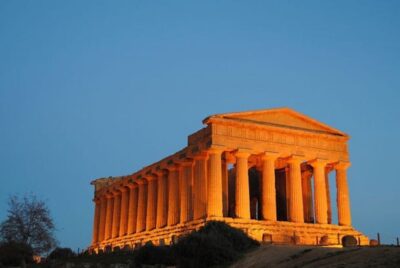
Agrigento and the Valley of the Temples Day Tour
Read our review →
Valley of the Temples Ticket & App Audioguide
Read our review →
Valley of the Temples and Scala dei Turchi Day Trip
Read our review →
Valley of the Temples and Turkish Steps with Snack
Read our review →
Valley of the Temples Entry Ticket & Audio Guide
Read our review →Browse the lists this tour appears in